
When mental health symptoms start affecting your relationships, your work, or just your ability to get through a normal day, reaching out for professional support is a necessary step. But deciding to get help is really just the beginning- the most important thing is figuring out what kind of help actually fits your situation.
Inpatient care means staying at a hospital or residential facility with round-the-clock support. Outpatient implies you continue living at home and attend scheduled appointments. Both are valid paths- they just serve different levels of need. If you’re exploring mental health treatment Houston, understanding what separates these two options can make the whole process feel a lot less confusing.
What Are Inpatient and Outpatient Mental Health Treatments?
Both strategies have the same objective, i.e., achieving improved mental health, but they differ in organization, intensity, and environment.
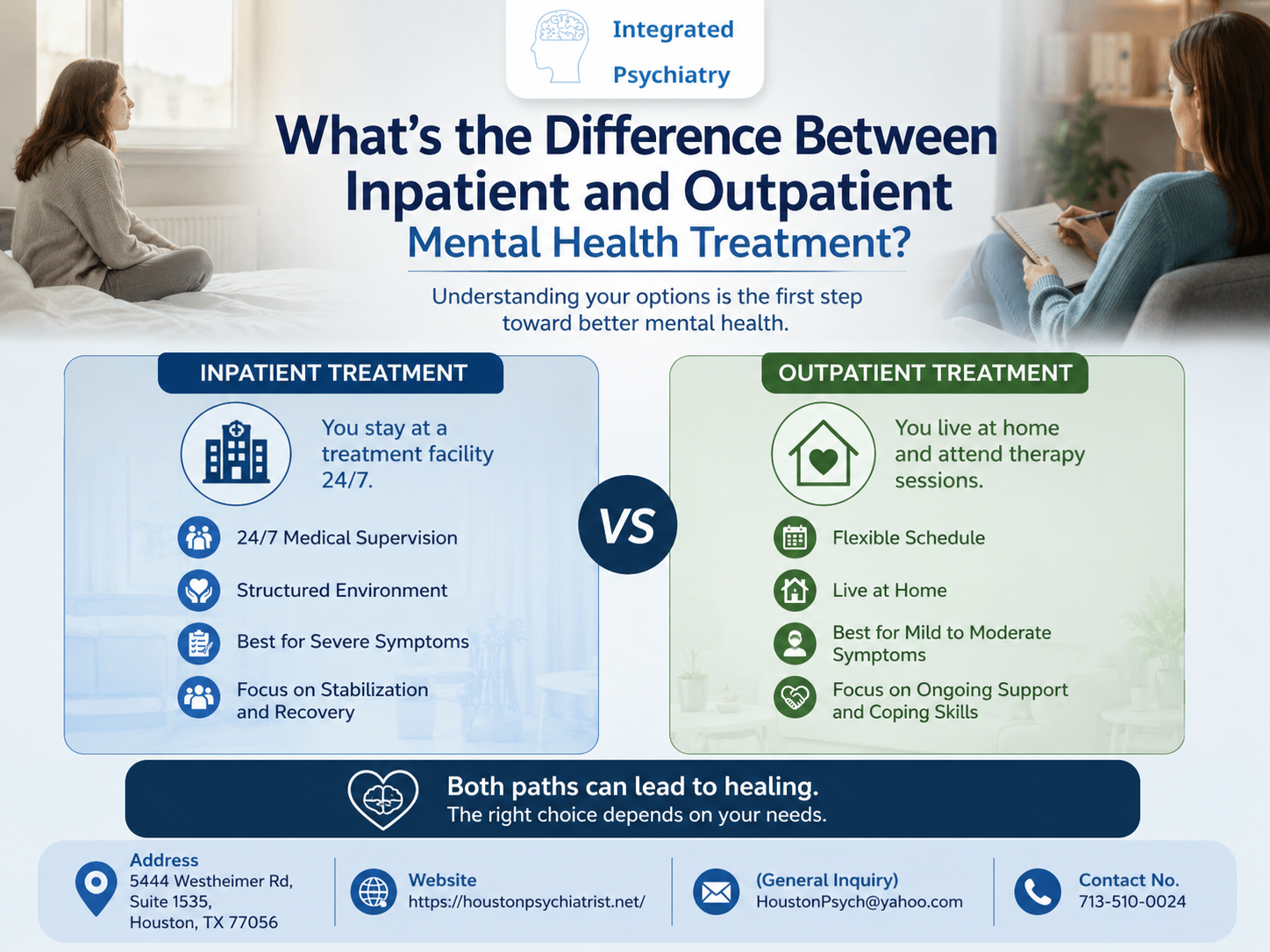
Inpatient care implies living in a hospital or residential center around the clock, with 24-hour surveillance, medication, and therapy. This level of care is recommended when a person’s symptoms are severe enough that staying at home would not be safe, even with intensive treatment.
Outpatient care implies remaining at home, continuing normal activity, and visiting the psychiatrist or the therapist at the designated time periods. This type of therapy ensures that one receives actual psychiatric assistance without having to give up work and family responsibilities.
| Feature | Inpatient | Outpatient |
| Living arrangement | Hospital or facility | Home |
| Level of care | 24/7 supervision | Scheduled appointments |
| Best for | Severe symptoms or crisis | Mild to moderate symptoms |
| Duration | Days to weeks | Weeks, months, or ongoing |
| Daily structure | Highly structured | Flexible |
One isn’t better than the other. What matters is matching the level of care to what someone is actually going through.
When Is Inpatient Treatment Recommended?
Inpatient therapy is the best form of treatment when a person’s condition has reached a stage where outpatient treatment cannot keep them stable or safe.
It could be recommended by a psychiatrist when a person:
- Is having suicidal thoughts
- Has intentions of hurting others
- Has depression to an extent that they can no longer perform their everyday activities
- Is undergoing acute psychosis or hallucinations
- Is having severe manic episodes
- Is on medications that require close medical attention
The objective of inpatient care is to stabilize a person, and not keep them there forever. The patients get a treatment team that continuously monitors them as they create a treatment plan for the future.
Who Benefits from Outpatient Treatment?
Outpatient care suits people whose symptoms, while real and significant, can be managed safely without around-the-clock supervision. It provides structured psychiatric support while leaving room to hold onto the normal parts of life.
Many Houston mental health treatments are built around outpatient services for conditions including:
- Anxiety disorders
- Depression
- ADHD
- OCD
- PTSD
- Stable bipolar disorder
Treatment typically includes evaluations, medication management, regular follow-ups, and therapy referrals where needed. Those regular check-ins matter because they make it possible to catch a shift in symptoms early and adjust before things escalate.
Can the Same Condition Be Treated in Either Setting?
Most mental health conditions can be treated in either setting. The diagnosis itself rarely determines the appropriate level of care- symptom severity does.
Someone managing depression well with medication and regular appointments is a reasonable outpatient candidate. That same person, going through a crisis with active suicidal ideation, may need a short inpatient stay first before stepping back into outpatient care. The diagnosis didn’t change- the circumstances did.
Conditions treated across both settings include major depressive disorder, bipolar disorder, generalized anxiety disorder, PTSD, OCD, ADHD, schizophrenia, and co-occurring conditions.
How Do You Choose the Right Level of Care?
This decision should always be made with the guidance of a mental health professional. A comprehensive psychiatric evaluation looks at the full picture before any recommendation is made- symptom severity and duration, current safety concerns, mental health history, previous treatment responses, day-to-day functioning, and what support exists at home.
That’s what produces a recommendation that fits the individual, rather than a generic answer based on a diagnosis alone.
Can You Move Between Inpatient and Outpatient Care?
Yes, and it happens regularly. Someone might go through an inpatient stay during a crisis and transition to outpatient care once stable. Someone in outpatient treatment might need a temporary inpatient stay if things take a serious turn. Neither represents a setback- it’s the treatment responding to what’s actually happening.
Regular psychiatric follow-up is what makes these transitions work. It tracks progress, catches problems before they grow, and keeps the treatment plan aligned with where someone actually is.
Finding the Right Treatment in Houston
If you’re looking into mental health treatment Houston TX, a proper psychiatric evaluation is the right starting point. It brings clarity to both the nature of the symptoms and how severe they are, which is what any solid treatment plan needs to be built on.
At Integrated Psychiatry, patients receive individualized outpatient psychiatric care shaped around their specific circumstances- diagnostic evaluations, medication management, and consistent follow-up that supports real long-term progress as part of mental health treatment in Houston.
Some people do need the more intensive support of a mental health treatment center in Houston TX at certain points, and that’s completely reasonable. Many others find that well-structured outpatient care fits naturally into their lives and delivers results that hold up over time.
Whatever brought you here- anxiety, depression, bipolar disorder, ADHD, or something still being worked out- an experienced psychiatrist means you don’t have to navigate it alone.
Taking the First Step
Inpatient care handles acute situations where intensive support is what’s needed. Outpatient care handles the longer work of recovery that fits around a real life. Which one is right depends on your symptoms, your history, and your goals.
If you’re unsure where you fall, a psychiatric evaluation is the most useful first move. It replaces guesswork with a real clinical recommendation, and from there, treatment can be built around what you actually need.
FAQs
1. Is inpatient treatment better than outpatient?
Neither is universally better. It comes down to symptom severity, safety concerns, and what a clinical evaluation actually shows.
2. How long does outpatient treatment last?
It varies. Some people need a few focused months. Others benefit with longer-term medication management and periodic check-ins over time.
3. Can I continue working while being treated as an outpatient?
Absolutely, the timing of the sessions is made according to your current schedule, and you will be encouraged to continue working or studying.
4. Is mental health care covered by my insurance?
In many cases, yes, but the details may differ. Check with your insurance company directly.
5. How do I know which type of care I need?
A psychiatric evaluation is the clearest answer. It looks at your full picture and gives you a specific recommendation rather than a general one.