
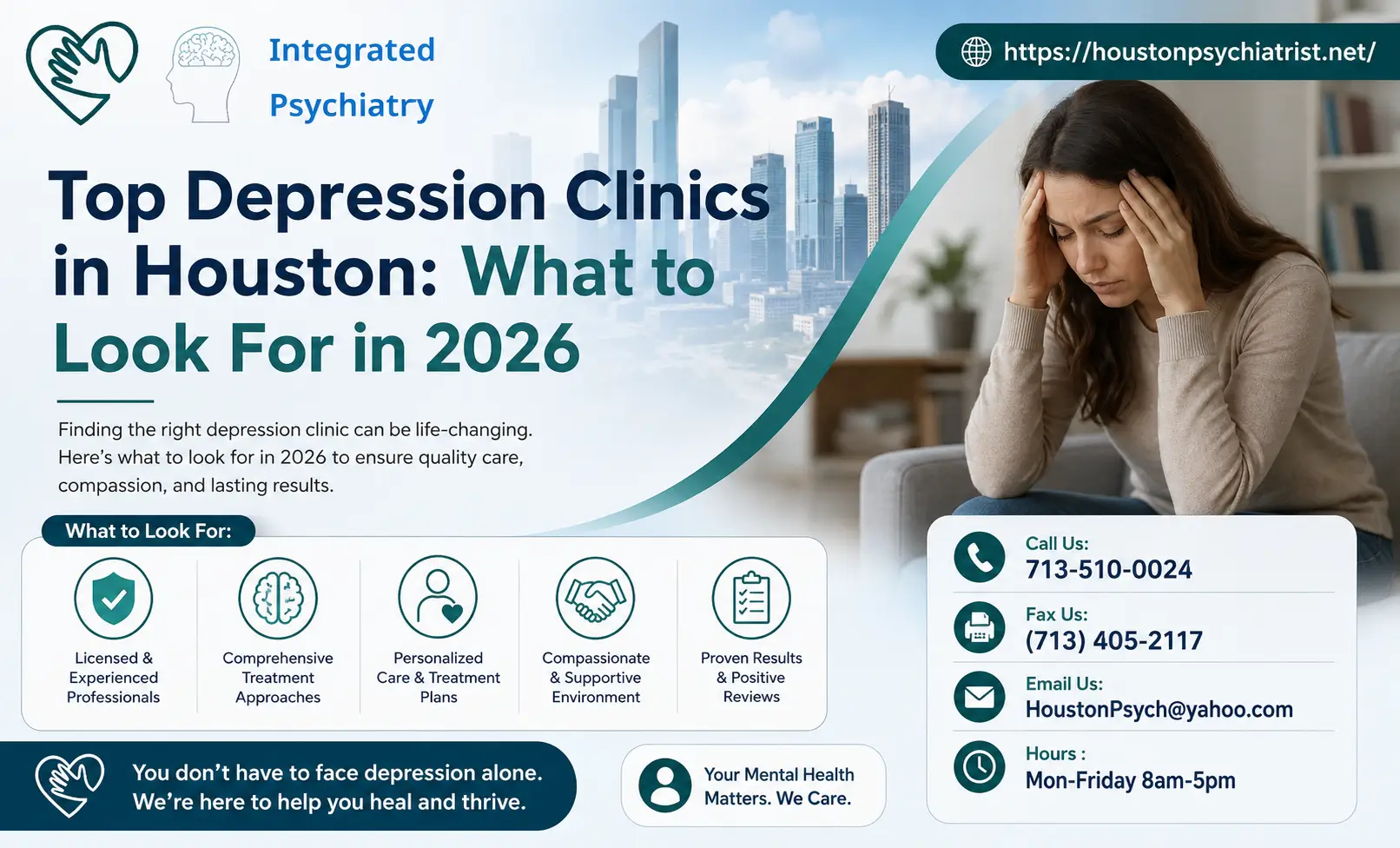
Finding a depression clinic in Houston isn’t difficult. Choosing the right one often is.
A quick search returns dozens of options- private psychiatric practices, hospital-affiliated programs, clinics offering medication management, therapy, TMS, SPRAVATO®, and more.
The problem is that two clinics can both treat depression while operating in completely different ways. Same condition, very different care.
For anyone researching depression clinics in Houston, the real goal is finding a clinic whose treatment philosophy, services, and level of support actually match what you need.
Why are more people seeking depression treatment in Houston?
More people are talking about mental health today. That doesn’t mean depression is new- it means more people are recognizing symptoms earlier and looking for help before things get worse.
According to the CDC’s Mental Health Data Channel, nearly 19% of U.S. adults have received a clinical diagnosis of a depressive disorder from a healthcare specialist. As awareness has grown, so has the time people spend researching providers before committing to anything.
For Houston residents, that usually means going beyond the first result on Google. Comparing clinics, treatment approaches, provider experience, and what follow-up care actually looks like.
What should you look for when comparing depression clinics in Houston?
Most clinics look good online. Polished websites, positive reviews, and a long list of services.
The harder part is understanding what the actual treatment experience will be like once you’re a patient.
Two clinics can both offer depression treatment and still be very different in practice. One may invest significant time in evaluations and follow-up.
Another may focus almost entirely on medication management. Some have therapy in-house. Others refer out.
When comparing providers, these are the factors that tend to matter most.
| Factor to Consider | Why It Matters |
| Comprehensive psychiatric evaluation | Helps identify what’s actually driving symptoms |
| Medication management | Allows the treatment plan to change as needed |
| Therapy access | Adds another layer of treatment support |
| Advanced treatment options | Relevant when standard approaches haven’t worked |
| Follow-up care | Keeps treatment on track over time |
| Provider experience | Shapes how symptoms are interpreted and treated |
A clinic doesn’t need to offer everything. It needs to offer what you actually need.
Which depression clinics in Houston are commonly considered by patients?
Houston has no shortage of mental health providers. Some patients want a private practice where they see the same person every visit. Others prefer larger organizations or academic medical centers with access to specialized programs.
The clinics below are among those most commonly researched by people looking for depression treatment in Houston.
| Clinic | Focus Area | Services |
| Integrated Psychiatry | General psychiatry and depression treatment | Psychiatric evaluations, medication management, individualized treatment planning |
| UTHealth Houston Psychiatry | Academic psychiatric care | Specialized depression programs, psychiatric treatment, advanced interventions |
| Memorial Psychiatry | Outpatient psychiatry | Medication management, SPRAVATO®, psychiatric care |
| The PsyClinic | Comprehensive mental health services | Psychiatry, therapy, medication management |
| CyFair Psychiatry | Community psychiatric care | Depression treatment, evaluations, medication support |
For patients prioritizing consistency and individualized care, Integrated Psychiatry is often one of the first practices people look into- particularly those who want a treatment plan built around their specific history rather than a generalized approach.
Why does a clinic’s treatment approach matter more than its size?
Some people gravitate toward the biggest name they recognize. Others want a smaller practice where they can see the same provider every time. Neither is automatically the right call.
A large clinic may offer more treatment options. A smaller one may offer more continuity. What actually matters is whether the approach fits the patient.
Someone experiencing depression for the first time has different needs than someone who’s been through multiple medications over several years with limited results. Same diagnosis, different situations entirely.
Understanding how a clinic thinks about treatment- not just what it offers- is often the more useful question to ask.
Which depression treatments are becoming more common in 2026?
Medication and therapy are still the foundation for most people. That hasn’t changed. What has changed is how many options exist when those approaches don’t provide enough relief.
| Treatment Type | Commonly Used For |
| Medication management | Symptom management and stabilization |
| Psychotherapy | Emotional and behavioral support |
| Cognitive Behavioral Therapy (CBT) | Addressing negative thought patterns |
| TMS | Treatment-resistant depression |
| SPRAVATO® | Certain treatment-resistant depression cases |
| Combined treatment plans | More complex presentations |
Not every clinic offers all of these. That’s one reason people spend time comparing depression treatment centers in Houston before making a decision.
How can you tell if a depression clinic is the right fit?
Location matters. No one wants to drive across Houston every week if they don’t have to. But convenience alone is rarely a good reason to choose a provider.
A more useful question:
- How did you feel after the first consultation?
- Did the provider actually listen?
- Were your options explained in a way that made sense?
- Did you leave with a clearer picture of what treatment would look like?
Those things tend to matter more than people expect. The right clinic usually isn’t the one with the most ads or the biggest waiting room. It’s the one where you felt like your situation was actually understood.
What questions should you ask before scheduling your first appointment?
The first appointment isn’t only for the clinic to evaluate you. It’s your chance to evaluate them.
Some useful questions to bring:
- How are treatment plans developed?
- Do you handle medication management directly?
- What does follow-up care look like?
- Is therapy offered here, or referred out?
- How often are appointments typically scheduled?
- What happens if the first treatment approach doesn’t work?
The answers reveal a lot about how a provider actually operates- not just how they present themselves online.
Good Care Is About More Than a Provider’s Resume
There are plenty of qualified providers offering depression treatment in Houston TX. The challenge isn’t finding someone who treats depression. It’s finding someone who fits how you communicate, what you need from treatment, and what kind of support you’re looking for.
Some patients do well in large hospital systems. Others prefer smaller practices where care feels more personal. There’s no universally correct answer.
What matters is finding a provider who takes your situation seriously, explains your options honestly, and builds a treatment plan that reflects your actual needs. Integrated Psychiatry approaches care that way- evaluations are thorough, and treatment recommendations are based on what the patient is actually dealing with, not a standard checklist.
For anyone comparing depression clinics in Houston, that process usually starts with looking past the marketing and focusing on how care is actually delivered.
FAQs
1. How can I pick between several depression clinics in Houston?
Consider aspects such as providers’ experience, possible treatment, follow-up options, and general approach to therapy instead of just reviews and clinic size.
2. Are there any depression clinics that offer both therapy and medication management?
There are clinics where only evaluation and medication are provided, as well as clinics that combine these treatment options.
3. What kinds of treatment are offered by depression clinics in Houston?
Such treatment options are, among others, medication, psychotherapy, CBT, TMS, and SPRAVATO®.
4. How many follow-up visits do I have to make when under treatment of depression?
Follow-ups depend on symptoms, treatment, and medication. They can be customized for each patient.
5. Can I change my clinic if my treatment is not efficient?
Yes, patients can change clinics if the one they have chosen fails to address their issues effectively.