
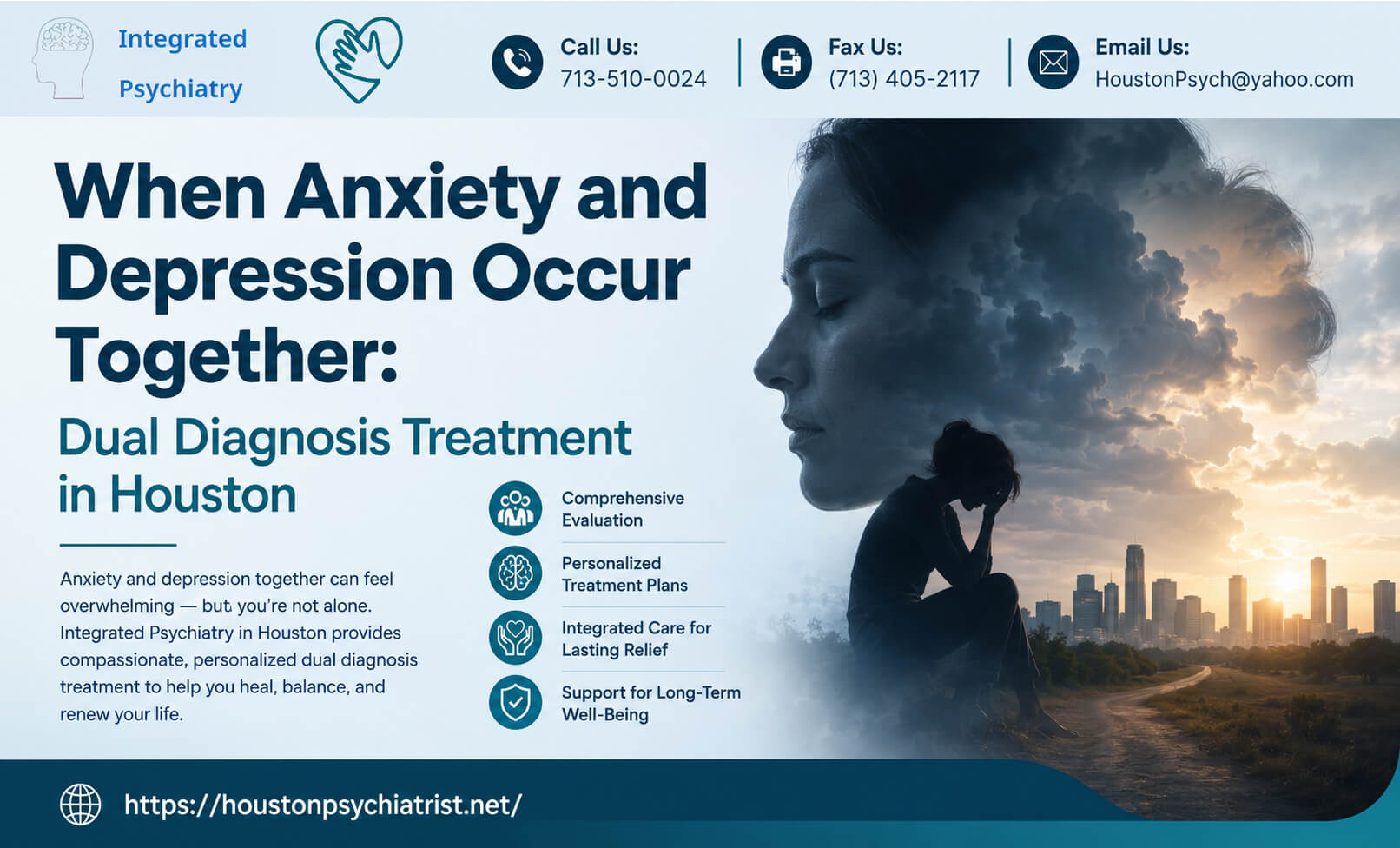
Living with anxiety is exhausting. Living with depression on top of it is something else entirely. It can feel like your mind is racing and completely stuck at the same time. If you recognise that feeling, you’re not alone, and you’re not imagining it. Co-occurring anxiety and depression is one of the most common dual diagnosis patterns seen in psychiatric care today. According to the Anxiety and Depression Association of America (ADAA), nearly half of people diagnosed with depression also meet the criteria for an anxiety disorder. At Integrated Psychiatry in Houston, we work with patients navigating exactly this combination every day, and our approach to anxiety treatment Houston patients rely on is built around treating both conditions together, not separately.
What Does It Mean to Have Both Anxiety and Depression?
Most people think of anxiety and depression as opposites. One makes you feel wound up; the other brings you down. In reality, they share overlapping brain chemistry, particularly around serotonin and norepinephrine pathways. When they occur together, each condition can intensify the other.
Some of the most telling signs that both are at play:
- Low mood that sits alongside a mind that won’t stop churning
- Bone-deep tiredness, yet you still can’t sleep properly at night
- Pulling back from friends or family because you’re dreading it and can’t be bothered at the same time
- Physical niggles like chest tightness, headaches, or an unsettled stomach with no clear cause
- Sleeping too little or far too much, sometimes swinging between both
- A sense that things won’t improve, wrapped up in constant worry that they’ll get worse
If that sounds like your daily reality, speaking with a qualified anxiety specialist Houston Texas sooner rather than later is the right call. You don’t have to wait until you hit rock bottom.
Why Is Dual Diagnosis Treatment Different, and Why Does It Matter?
The Problem With Treating Them One at a Time
Historically, mental health treatment has tended to address one condition at a time. A patient might be treated for depression first, only to find that once the low mood lifts, the anxiety becomes even more pronounced, or vice versa. This sequential approach often leaves patients cycling through partial recoveries without ever feeling genuinely well.
Dual diagnosis treatment takes a different approach. Rather than prioritising one condition over the other, it maps the relationship between them. Sometimes anxiety is the driving force that feeds depression. Other times, chronic low mood creates the fertile ground from which anxiety grows. Understanding which came first, and how they interact in your specific case, shapes every part of the treatment plan.
If you’ve been looking into anxiety treatment Houston TX options and haven’t found care that also addresses your mood symptoms, it’s worth asking directly whether the practice you’re considering has experience with co-occurring conditions.
How Does Integrated Psychiatry Approach Co-Occurring Anxiety and Depression?
At our Houston practice, we use a genuinely integrated model, which is where our name comes from. Our evaluation process looks at the full clinical picture before anything else. We don’t hand out a diagnosis and a prescription on day one. We take time to understand what’s actually going on.
Our care typically covers:
- Full psychiatric evaluation: we look at your symptoms, personal history, lifestyle, and anything you’ve tried before
- Medication, where it fits: SSRIs and SNRIs can work well for both anxiety and depression, and we’ll talk you through the options honestly
- Structured therapy: CBT in particular has solid evidence behind it for both conditions
- Regular check-ins: so we can see what’s shifting and adjust as needed
- Wider support: sleep, routine, stress levels and social connection all feed into recovery, and we address those too
We offer houston anxiety treatment that goes well beyond symptom suppression. Our goal is lasting functional wellbeing, not just getting through the day.
If you’re ready to speak with someone, contact our team to schedule an initial consultation.
Are There Specific Therapies That Work Best for This Combination?
What the Evidence Actually Shows
CBT has the strongest research backing here. A 2021 review in JAMA Psychiatry found it effective specifically for patients carrying both conditions, because it targets the thought patterns driving each one. Where avoidance is a major factor, ACT often works better. It helps people stop fighting their internal experience and start functioning again, rather than organising their whole life around what they’re trying to avoid.
Mindfulness-based approaches are useful too, particularly when someone’s caught in a loop of rumination that rest and distraction don’t touch.
On the medication side, SSRIs aren’t right for everyone, but sertraline and escitalopram act on the same neurological pathways that underpin both conditions. One prescription, addressing both. It’s worth discussing if therapy alone isn’t shifting things fast enough.
What doesn’t work is picking a treatment based on whichever diagnosis came first and hoping it filters through to the other.
Can Anxiety Treatment in Houston Address Long-Term Recovery?
This is one of the most common questions we hear, and it’s worth addressing directly. Anxiety treatment in Houston at Integrated Psychiatry is not structured around crisis management alone. Whilst acute symptom relief matters enormously, especially in the early weeks of treatment, the longer arc of care matters just as much.
Long-term recovery from co-occurring anxiety and depression typically involves:
- Learning to identify and interrupt patterns before they escalate
- Building a sustainable daily routine that supports mental health
- Addressing any underlying contributors, such as unresolved trauma or chronic stress
- Gradually reducing reliance on coping mechanisms that worked short-term but aren’t sustainable
Patients who engage with consistent, evidence-based care, rather than stopping treatment the moment they feel slightly better, have substantially better outcomes over a 12-to-24-month horizon.
If you’ve had previous treatment that didn’t quite get you where you wanted to be, we’d encourage you to explore our services page to see how our approach differs.
What Should You Do If You Think You Have Both Anxiety and Depression?
The single most useful thing you can do is seek a proper evaluation rather than self-diagnosing or waiting to see if things improve on their own. Both conditions are highly treatable, particularly when caught before they become deeply entrenched.
Here’s what to expect when you reach out to us:
- A warm, non-judgemental consultation environment
- No pressure to commit to a specific treatment path before you’ve asked all your questions
- A clinician who listens to the full picture, not just a checklist of symptoms
Call us at 713-510-0024 or visit us at 5444 Westheimer Rd, Suite 1535, Houston, TX 77056. Taking that first step is often the hardest part, but it’s the one that changes everything.
Finding the Right Support for Anxiety Treatment Houston Texas
Whether you’re at the beginning of your mental health journey or you’ve been managing these conditions for years without quite finding the right fit, specialised dual diagnosis care can make a real difference. Anxiety treatment Houston Texas patients receive at Integrated Psychiatry is built on clinical rigour, genuine compassion, and the understanding that no two people experience these conditions in exactly the same way.
We’re here when you’re ready. Get in touch with our team today.
Frequently Asked Questions
1. Can anxiety and depression really be treated at the same time?
Yes, and in most cases it’s better that way. Treating one in isolation often leaves the other untouched, which is why so many people feel like they’ve improved but never quite got there. A joined-up approach addresses both from the start.
2. How do I know if I need anxiety treatment in Houston or just general counselling?
If anxiety is getting in the way of your sleep, your work, or your relationships on a regular basis, a psychiatrist is a better starting point than general counselling. You’ll get a proper diagnosis and a clearer picture of what’s driving things.
3. What makes Integrated Psychiatry’s approach to anxiety treatment Houston TX different?
Most places treat whichever condition is loudest. We don’t. When anxiety and depression show up together, we spend time figuring out how they’re feeding each other in your specific situation before settling on a plan. That extra step tends to matter a lot for long-term outcomes.
4. How long does dual diagnosis treatment usually take?
It varies. Some people notice a real shift within two to three months. For others, particularly where symptoms have been building for years, the process is longer. What matters is staying with it rather than stopping when things feel slightly better.
5. Is houston anxiety treatment covered by insurance?
It depends on your plan. Ring us on 713-510-0024 and we can go through your options. A lot of patients find psychiatric care more affordable than they were expecting.