
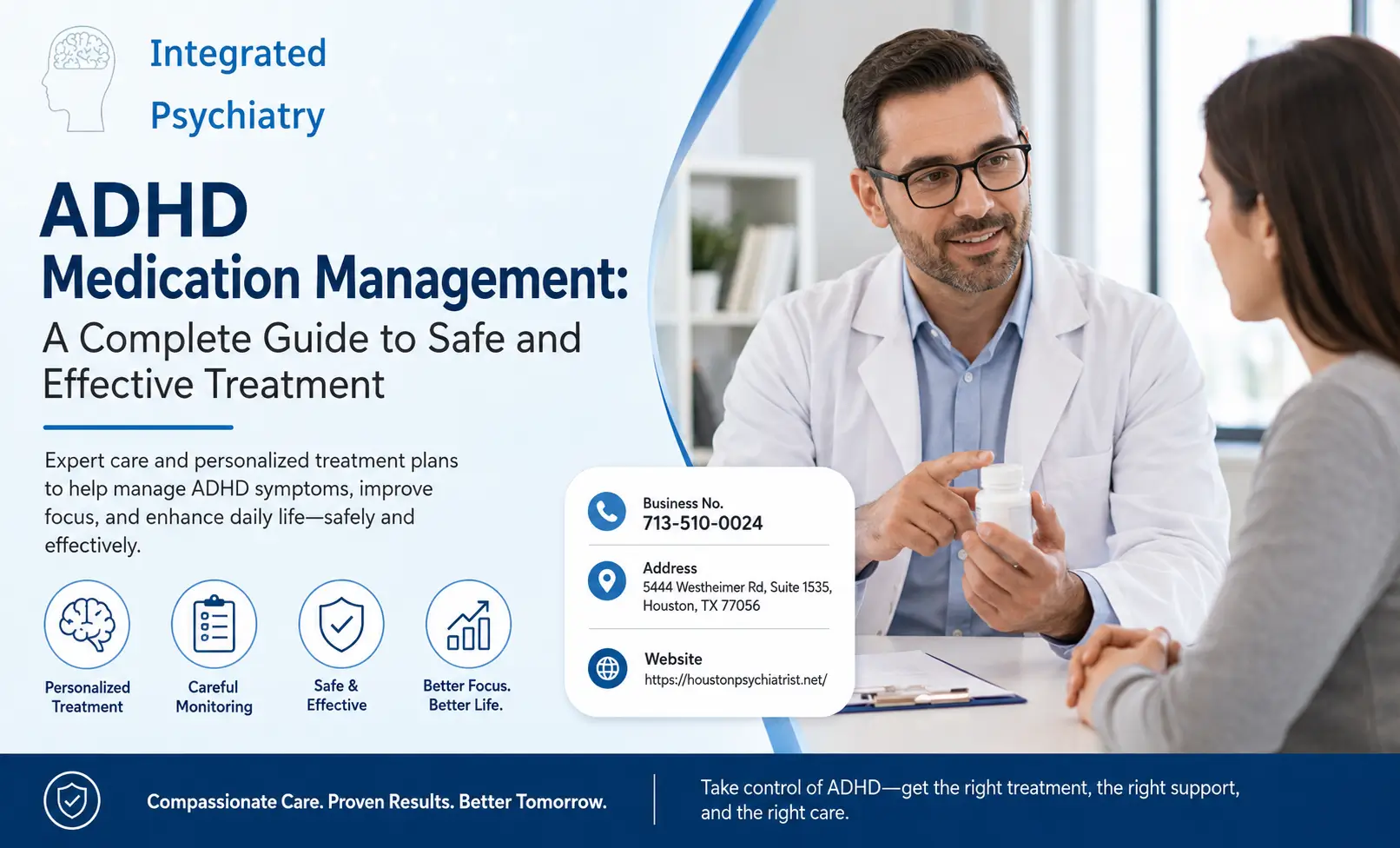
Medication can play a substantial role in managing ADHD, but its effectiveness depends on how it’s prescribed, adjusted, and monitored. With support from an ADHD treatment center in Texas like Integrated Psychiatry, patients can get structured care that focuses on balancing effectiveness, safety, and long-term results.
A prescription alone isn’t treatment. ADHD shows up differently in different people, responds differently to the same drug, and shifts over months in ways a single appointment can’t catch.
Medications work differently for everyone, so they get revisited regularly, not just renewed every few months.
The effectiveness of ADHD medication management tends to show up over time, in how stable symptoms stay and how well treatment fits into daily life.
What is ADHD medication management and why does it matter?
It’s the process of prescribing, tracking, and adjusting medication so it keeps doing its job — not a one-time event, but a loop that continues for as long as treatment does. Why it matters comes down to how inconsistent ADHD is from person to person.
One patient struggles mainly with focus. Another deals more with impulsivity. A third has trouble with both, plus sleep issues that complicate things further.
Medications lose effectiveness sometimes, for reasons that aren’t always obvious. Side effects can appear gradually enough that they’re mistaken for something unrelated.
Without someone watching for that pattern, treatment drifts away from what the person actually needs, even while the prescription stays the same on paper.
How does ADHD medication management actually work?
It starts with an assessment covering symptoms, medical history, and daily routine, often including questions about sleep and stress that may not seem directly related at first. Then a low starting dose, mostly to see what happens before anything is adjusted further.
The first prescription is rarely the final one. It functions more as a starting point than a settled plan.
Over the following weeks, doctors monitor:
- Attention span
- Emotional regulation
- Sleep patterns
- Energy levels throughout the day
Some patients respond fast, noticing a difference almost immediately; others need several rounds of small adjustments before anything clicks into place.
Based on what shows up during that period, the dose stays the same, gets nudged slightly, or the medication itself gets swapped out for something else.
That slow, iterative process- guided by real feedback- is what makes treatment safe over the long term.
What types of medications are commonly used for ADHD treatment?
| Category | How It Works | Best Suited For |
| Stimulants | Act quickly, often improving focus within hours to days | Patients seeking faster relief, where side effects are well tolerated |
| Non-stimulants | Slower to show results, typically a few weeks | Patients who don’t respond well to stimulants, or who need steadier, more gradual control |
There is no single “best” option. What works depends on you, your response, your daily routine, and how your symptoms present from one day to the next.
How do doctors decide the right ADHD medication and dosage?
Mostly gradually and in small steps. Doctors typically start at the lowest dose likely to help, then watch closely for how the body and mind respond over the following weeks.
If it works without discomfort, it stays as is. If the improvement is only partial, the dose moves up in small, measured steps rather than large jumps. If it’s not working at all, or side effects are too disruptive, the medication may be changed rather than only adjusting the dose.
The target isn’t the strongest dose available- it’s the smallest one that still gets the job done, since more medication isn’t automatically better medication.
Why is regular monitoring important in ADHD medication management?
Without it, treatment becomes far less predictable.
A drug that worked well in March might not work as well by August. Lifestyle changes- sleep, stress, diet, even physical growth in younger patients- can shift how a medication behaves in ways that aren’t always predictable.
Doctors typically track:
- Focus and attention during daily tasks
- Sleep quality
- Appetite changes
- Mood shifts
- Emerging side effects
Small changes in any of these can signal the need for adjustment, often before more obvious symptoms return. That ongoing check-in is what keeps treatment from sliding backward unnoticed.
How does ADHD treatment in Houston support structured care?
Continuity, mostly- not a single visit followed by an indefinite refill schedule, but ongoing review built into the process from the start.
Patients are followed over time: how they’re functioning at work, in school, at home, and in relationships, not just whether a symptoms checklist looks marginally better at the next appointment.
This is also how ADHD treatment in Houston, Texas approaches care, including providers such as Integrated Psychiatry, focusing on real-life functioning rather than just symptom checklists.
That structure cuts down on guesswork. It also keeps treatment tied to how someone’s actually living day to day, rather than how they responded during the first few weeks.
When should you consider professional ADHD treatment in Houston?
A lot of people wait. Symptoms feel manageable, at least for a while, until forgetfulness, disorganization, or restlessness start affecting work, school, or relationships in ways that are harder to dismiss.
At that point, seeking structured care such as an ADHD treatment center in Houston can help bring things back under control in a more stable way.
Earlier treatment tends to go better overall, since adjustments can happen gradually rather than being rushed through after symptoms have already become more severe.
What This Comes Down To
ADHD Medication management isn’t a single decision made once and left alone. It’s monitoring, adjusting, and re-evaluating, repeated for as long as treatment is needed.
When done properly, that process is what separates basic symptom management from treatment that genuinely improves daily functioning over time- an approach followed at Integrated Psychiatry.
FAQs
1. Does ADHD medication work immediately?
Stimulants can act within hours. Others take longer to build up an effect. Either way, landing on the right medication and dose usually takes a few rounds of adjustment.
2. Why do ADHD meds need tweaks?
Because we’re all different- and those differences change over time. That’s how treatment adapts to our ever-changing needs.
3. Can ADHD medicine wear off?
Yes, sometimes. The body gets used to it, life circumstances evolve. Sometimes effectiveness fades away slowly enough that you might not notice unless you’re paying close attention.
4. Is ADHD medicine enough by itself?
It helps treat the symptoms, but long-term improvement usually requires regular follow-ups and an overall approach beyond just the prescription.
5. What if my first medicine doesn’t work?
It’s pretty common. Trying out multiple options before settling on the right fit is a perfectly normal part of the process.